Freight insights / 3 min read
Freight Tracking: What Customers Actually Need to See
Freight tracking often gets reduced to location, but customers usually need something more useful: confidence. They want to know what happened, what comes next, and whether they need to take action.
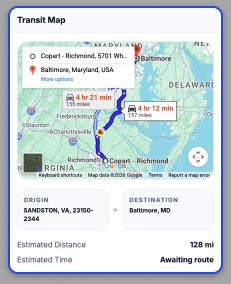
The most useful tracking milestones
A customer-friendly tracking view should show pickup scheduled, driver assigned, picked up, in transit, delayed if applicable, border or port milestone, out for delivery, delivered, and proof of delivery.
For ocean freight, milestones may include container loaded, vessel departed, vessel arrived, customs or release status, available for pickup, and final delivery. For vehicles, condition photos and handoff notes can matter as much as location.
Customers need ETA context
An ETA without context creates false certainty. Better tracking explains whether the shipment is on schedule, whether the ETA changed, why it changed, and what the next milestone is.
That matters for shippers, dealers, auction buyers, and brokers because downstream planning depends on the delivery window.
- Current status.
- Next expected milestone.
- ETA confidence and reason for change.
- Exception details and owner.
A tracking view customers can use
| Show | Include | Avoid assuming |
|---|---|---|
| Current stage | Event, source, timestamp | Last location means continuous live GPS |
| ETA | Window, dependency, reason for change | A prediction is a guaranteed appointment |
| Border or port status | Actual release and availability milestones | Arrival means cargo can be collected |
| Delivery | Recipient, receipt, exceptions | Delivered means no damage or shortage |
Documents belong in the tracking experience
Customers often track freight because they need a document: bill of lading, delivery receipt, photos, customs paperwork, title copy, release form, proof of delivery, or invoice support.
Putting documents near shipment status reduces support calls and makes the shipment record easier to close.
Agree on visibility before the booking
Ask which milestones the booked service supports, where updates come from, and how the customer can access the shipment record. Different carriers and transport modes can provide different levels of detail.
Fleet X Direct customers should use the tracking reference supplied with the booking and contact the team if a required event is missing or unclear. Tracking expectations belong in the service discussion before the cargo moves.
Show the source and freshness of each update
A timestamp helps customers distinguish a recent event from old information. Label whether the status came from a carrier, driver report, terminal event, or another connected source. Avoid presenting the latest known location as continuous live tracking if the feed has stopped updating.
When a source is unavailable, tell the customer what is known, what is awaiting confirmation, and when the next update is expected. A clear statement of uncertainty is more useful for a receiving team than an apparently precise ETA with no dependable basis.
Design an exception update around a decision
A practical message contains the shipment reference, event, impact, next action, owner, and next update time. For example: delivery is awaiting a revised appointment; the receiving contact has been notified; dispatch will confirm the new window by 14:00. That gives the customer a reason to act or a clear point to check again.
Avoid sending repeated alerts that add no new information. Notify the right recipient when an event affects their work: a shipper for pickup readiness, a broker for a release issue, or a dealer for a changed delivery window. Keep the event history available without treating every minor movement as an urgent notification.
Close the move with evidence and controlled access
The final record should show when and where delivery occurred, who received the shipment, and which quantity or condition exceptions were recorded. For vehicles, the handoff inspection matters; for cargo, piece counts and delivery remarks can explain a later discrepancy.
Give users access only to documents appropriate for their role. Commercial invoices, personal details, titles, and other sensitive records should not be exposed through an unrestricted tracking link. A shipment can be marked delivered while a document review or billing question still remains open, so define those closeout stages separately.
Turn the details into a shipping plan.
Send your route, cargo, and timing to the Fleet X Direct team.
Discuss a shipment